CESET work package 4 – the living energy lab complete!

5th December, 2025

Work package 4 of the CESET project involved creating a Community Energy Laboratory – a non-commercial microgrid within the city of Maputo – serving as a practical demonstration site to deliver theoretical and empirical evidence into what works for community energy systems.

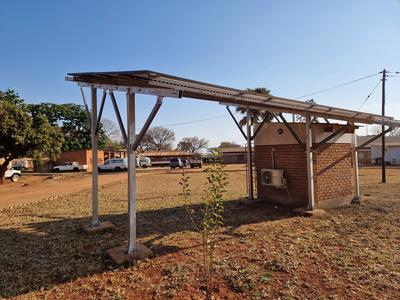
The Community Energy Laboratory involved the installation of a solar kiosk and streetlight in Chamanculo, Aeroporto A neighbourhood, delivered by Africa Energy Services: Solar Panel and Engineering.

Context and Rationale

The area of Aeroporto A neighbourhood, faces high population density, limited infrastructure, and inadequate public lighting, which contributes to insecurity, road accidents, and restricted nighttime economic activity. Small-scale businesses (barbers, tailors, food vendors) depend heavily on affordable and stable energy access to sustain their operations.

Introducing a solar kiosk will provide the community with affordable, reliable, and clean energy services, such as phone charging, and small appliance powering, helping bridge the energy access gap. Installing solar-powered streetlights will significantly improve security and mobility at night, reduce gender-based violence risks. The project will support income-generating activities, creating new business opportunities around the kiosk while lowering energy costs.

Project objectives

Solar Kiosk:

  • Provide affordable electricity for the local community.
  • Support local entrepreneurship (food vendors, locksmith).

Streetlights:

  • Enhance community safety and mobility after dark.
  • Enable evening social and economic activities.

Stakeholders

  • Local community leaders & residents.
  • Project implementers (NGOs/private sector).
  • Technology providers (solar panels, batteries, LED lights).
  • Municipality of Maputo.
  • Donors and development partners.
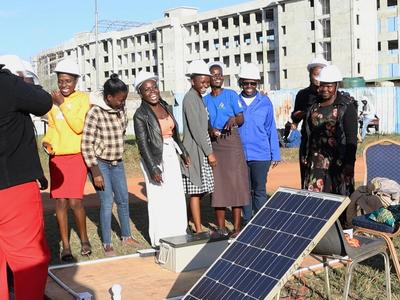
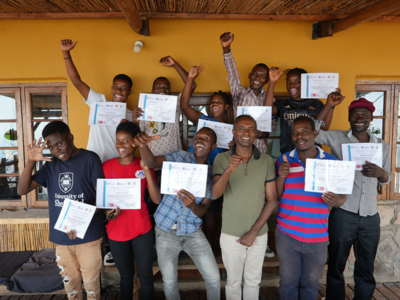
  • Young people interested in receiving technical training in solar energy and improved stoves.

Project design and components

Kiosk

  • Container-based kiosk with rooftop solar panels.
  • Battery storage for night-time operation.
  • Services: Locksmith, sale of fast food and beverages, Wi-Fi (future add-on).

Streetlights

  • Standalone solar-powered poles with LED lamps.
  • Distributed in key community areas: streets considered dangers during the night-time.

Services provided at the kiosk

  • Locksmith services - Gates, railings, stoves, structures, windows, and much more.
  • Beauty salon/barber shop.
  • Snack bar/fast food services.
  • An AEROSOL workroom, where training and capacity building programmes. developed by AEROSOL will be conducted.
  • AEROSOL will use the same room to provide training on renewable energy and improved stoves.

Infrastructure and installed electrical capacity in the multifunctional kiosk

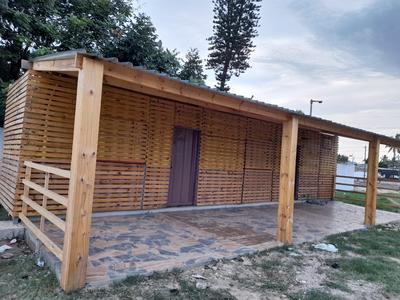
The kiosk has lighting and light sockets, and they will add a porch outside the kiosk to create shade, in a space of 3 metres. This space to be added will also be used for woodworking activities. A toilet/bathroom will be built outside the kiosk. 

The renewable energy system consists of:

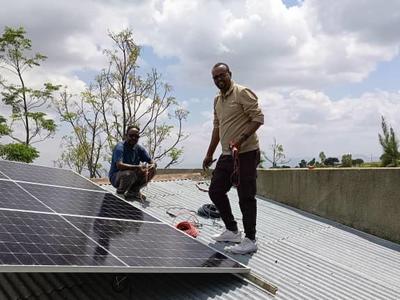
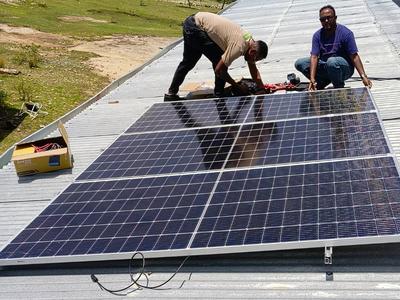
  • High-efficiency solar panels installed on the roof of the container.
  • A complete system with batteries and inverters to supply energy to all the units.
  • Energy self-sufficiency for lighting, computers, machinery, fridges and other light equipment.

General structure

  • Dimensions: 12m (length) x 3m (width) x 2.9m (height).
  • Openings: 2 reinforced metal doors (both doors at the front) and 3 windows with security grilles (one in the snack and grocery area at the side, one in the sawmill opposite and one in the document copying centre).
  • Internal thermal and acoustic insulation, finished in PVC or recycled wood;
  • 5 interior lighting points and 3 exterior lighting points;
  • 6 socket outlets, divided into high and low consumption.

Internal divisions - distribution designed to optimise space

  1. Hairdressing salon (3.5m) with cutting chair, large mirror, worktop, washbasin; sockets for cutting machines, hairdryer and soft LED light and a small storage cupboard.
  2. Copy and Print Centre (2.5m) with a multifunction printer, computer and service desk; shelving for paper and office supplies and external service window to speed up quick services.
  3. Basic Metalwork (3.5m) which is a room equipped with workbench, tools and mini welder; good ventilation and fire extinguisher and a reinforced floor and industrial sockets.
  4. Burger, soft drinks and essentials snack bar (2.5m) with a mini electric grill, fridge and shelves; a small outside service counter with cover and a window with plate rack to facilitate service.

Safety

  • The solar panels have been properly fixed with steel welding, impossible to remove without using cutting machines. We can assure you that they are completely secure.
  • The doors and windows have exterior and interior locks, and there are two types of lock, one of which has an alarm that sounds very loudly if anyone tampers with it. 
  • Around the kiosk there are armed security guards who also watch over the kiosk. 

Location

  • Easy access, on the road, streets very busy with people living in the neighbourhood.

Results

Impacts and benefits

  • Social: safer streets, improved quality of life, reduced gender-based violence risks.
  • Economic: support for small businesses, job creation (kiosk operators, technicians).
  • Environmental: lower carbon emissions.
  • Business continuity: Community members can sell their products in the neighbourhood at night.

Challenges

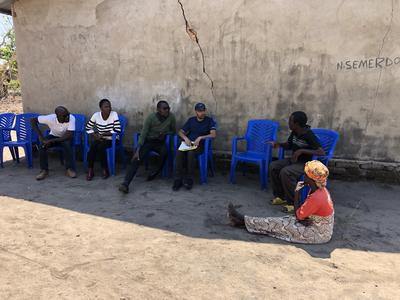
The living energy lab process in the neighbourhood began a long time ago and involved various stakeholders. Specifically, municipal authorities (the Chamanculo district administration), local leaders (the district's neighbourhood in general and the Aeroporto A neighbourhood in particular), block leaders, and the neighbourhood’s residents. A committee was established called AEROSOL to lead the socio-institutional and implementation process. 

[The AEROSOL Committee]

The project faced (and continues to do so) a wide range of social and institutional constraints and challenges. This included resistance from certain neighbourhood members to the municipal administration's lack of understanding, all of which were exacerbated by the post-election protests, which, having altered power relations in the country in general and at the neighbourhood level in particular, had significant implications for the project's implementation (as explained throughout the process).

AEROSOL, the local community, neighbourhood leaders, the neighbourhood administration, the Municipality, and the University worked tirelessly to overcome challenges. African Energy Services (AES) also acted beyond its scope of construction of infrastructure, to participate in the process to create and resolve problems.

Lessons learned

  • Need for community ownership for sustainability.
  • Dialogue between the community and the committee.
  • Criteria for inclusivity in the project process.
  • Clarity in the final model of the solar kiosk.
  • Change in the activities to be carried out at the kiosk.
  • Long waiting time for approval and granting of space for the installation of the kiosk.
  • Importance of reliable supply chain for spare parts.

Next steps and scalability

  • Expand streetlight coverage across Chamanculo/ a different place.
  • Introduce more kiosk services (e-mobility charging, e-cooking, internet -WIFI).
  • Replicate model in other neighbourhoods and rural communities.
  • Develop a long-term community-owned management model.

Conclusions

  • The Aeroporto A project demonstrates that decentralized solar solutions improve energy access, safety, and livelihoods.
  • It provides a scalable model for sustainable rural development in Mozambique.


Creating a Community Energy Laboratory