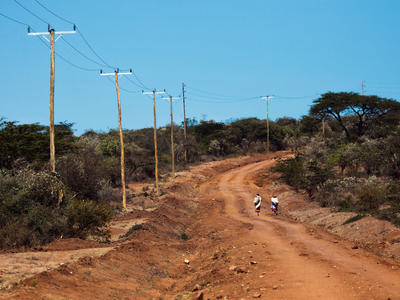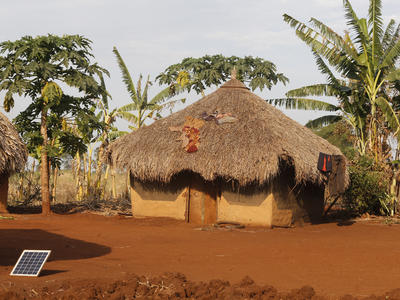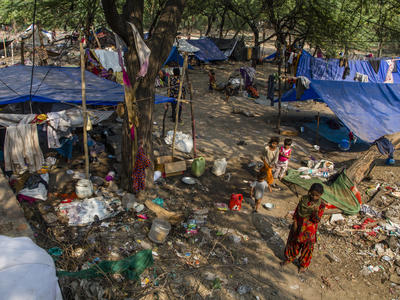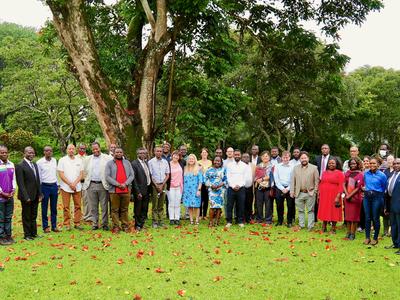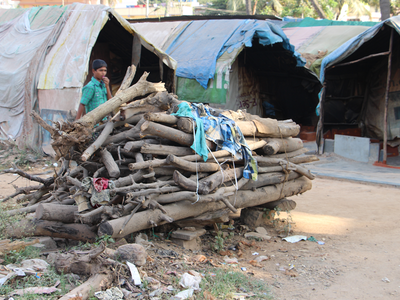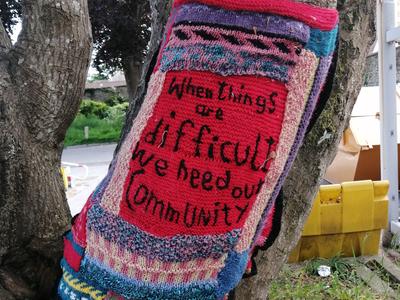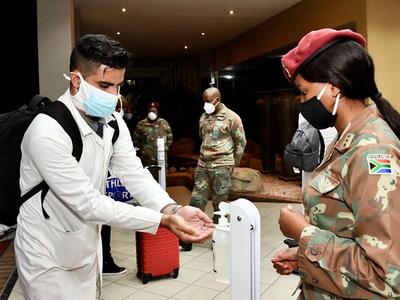
Last month the CESET team excitedly travelled to Malawi for its first face to face meeting as a project team! [Delayed due to COVID and travel restrictions]. The meeting was hosted by our Malawian colleagues at Mzuzu University. The team were in awe of Malawi’s beautiful green countryside and were made very welcome by the friendly people we encountered.
Congratulations to our CESET Principal Investigator, Professor Vanesa Castán Broto, on successfully applying for funding from the University of Sheffield’s ESRC Impact Acceleration Account (IAA). The University was awarded ESRC IAA funding to support the delivery of knowledge exchange and activities focused on generating impact from its social sciences research portfolio.
New open access article "From problematisation to propositionality"
30th April, 2022
Congratualtions to our UK CESET Dr Idalina Baptista and her colleague on a new publication in the Transactions of the British Institute of Britsh Geographers. "From problematisation to propositionality: Advancing southern urban infrastructure debates" explores the notion of propositionality to advance southern urban infrastructure debates towards more anticipatory forms of scholarship.
New open access article published on ‘The dynamics of urban household energy poverty and energy transition in Mozambique’
4th March, 2022
Congratulations to team members Carlos Shenga, Joshua Kirshner, Lorraine Howe and their colleague Matthew Cotton on the publication of a new article in People, Place and Policy. The article stems from the POLARIZE project funded by UK Aid/FCDO through the Energy and Economic Growth Applied Research Programme.
The CESET project team has just published its fourth briefing paper on “Towards an intersectional perspective on community energy: work-in-progress within CESET”.
An excerpt of ‘Urban Energy Landscapes’ available as audio book
16th February, 2022
CESET PI, Vanesa Castán Broto, has imagined the concept of urban energy landscapes as spatial arrangements of cultural practices and artefacts that reflect the coevolution of socio-economic, technological, and ecological systems. Her book Urban Energy Landscapes (2019, Cambridge University Press) presents the conceptual foundations of this approach.
A new report explores the question of urban inequality in the context of providing energy access and achieving the goals of the Sustainable Development Goal 7.
A switch to renewables could grow Africa’s economy by 6.4% in 2050
28th January, 2022
The International Renewable Energy Agency (IRENA) - a lead intergovernmental agency for the global energy transformation – in collaboration with the African Development Bank published “Renewable Energy Market Analysis: Africa and Its Regions” earlier this month. The report claims that energy-efficiency investments have the potential to boost the African economy by approximately 6.4% and create millions of new jobs.
CESET welcomes its newest team member Dominic Stephen, Project Coordinator at Scene. Dom joined Scene in 2018, with an MSc in Ecological Economics. He draws on his working and research experience across the UK, Kenya, Tanzania, and South Africa, driven to develop low carbon solutions which address environmental, economic, and social challenges holistically.
Beyond COP26 - progression of the CESET project and its ‘living lab’
29th November, 2021
Mozambique took part in COP26, where world leaders met to take decisions on how to drive the implementation of environmental initiatives to reduce and mitigate further effects of climate change. A key issue of discussion was to transition away from the use of fossil fuels and elimination by 2050 – a difficult issue given that Mozambique possesses major coal deposits, and it had been expected that coal would be a major driver of Mozambican development.
Our CESET co-investigators Collen Zalengera and Long Seng To and their colleagues have recently published an open access article “Unbending the Winding Path of a Low-Income Country’s Energy Sector amid the COVID-19 Pandemic: Perspectives from Malawi” in Energies. This paper discusses the impact of COVID-19’s vulnerability context on Malawi’s Energy Sector and outlines mechanisms for enhancing Malawi’s energy-sector resilience based on experiences from a range of stakeholders.
Very warm welcome to Martin Mganyasi who has recently joined our team as a researcher working with our colleague Dr Domingos Macucule from the Mozambique team. Martin is an Architect and Research assistant at the Center for Habitat studies and Development at Eduardo Mondlane University.
On 11th November 2021 the COP26 came to an end with a crucial discussion on the importance of cities in the climate agenda. The British Academy marked the event by publishing three briefings that examine how cities and urban communities can respond effectively to the climate crisis. The briefings highlight the significant contributions that cities have made to man-made global warming and the role they have to play in transformative action on climate change.
Paper published in a new special issue on urban impacts of climate change
16th November, 2021
Congratulations to our CESET principal investigator Professor Castán Broto and her collesgues Dr Linda Westman and Dr Ping Huang on their new paper published in a special issue.
Exploring the contours of off-grid and sustainable energy transitions in Mozambique, Ethiopia and Brazil
15th November, 2021
On Friday 12th November 2021 our CESET Co-Investigator Professor Joshua Kirshner was invited to give a presentation to staff and students in the Department of Environment and Geography, University of York.
Congratulations to CESET PI Professor Vanesa Castán Broto on the recent publication for The British Academy – “Just Climate Adaptation In Cities: Reflections For An Interdisciplinary Research Agenda".
The briefing focuses on three critical points for understanding what just adaptation means for cities: